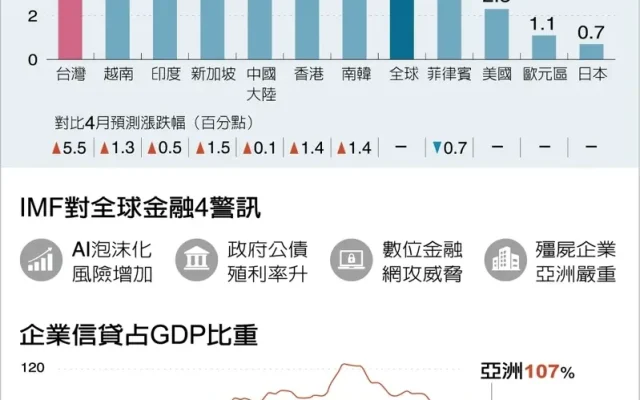
The Financial Times reports that the International Monetary Fund (IMF) warned on the 13th that major global economies are facing their most severe fiscal deficits since the COVID-19 pandemic. It is estimated that the fiscal deficits of both the United States and China will reach or exceed 8% of their respective gross domestic products (GDP) this year. With governments burdened by heavy debt and borrowing costs continuing to climb, the IMF has urged nations to take urgent steps to improve their fiscal positions, warning that failure to do so could trigger significant turmoil in financial markets.
In its latest World Economic Outlook report, the IMF projects that net borrowing by advanced economies will reach 5.2% of GDP by 2026—the highest level since the pandemic-related lockdowns of 2021. Specifically, the U.S. government’s fiscal deficit is expected to hit 8.5% of GDP, up from 7.1% last year, while China’s deficit is also projected to reach or exceed 8%.
Even more concerning is that governments are not only taking on more debt but are also facing higher interest payments. Driven by soaring energy prices and persistent inflationary pressures, central banks in the U.S., the Eurozone, and Japan have raised interest rates, which has pushed up the cost of government borrowing.
The IMF forecasts that global public debt will approach 100% of GDP by 2030. IMF Chief Economist Pierre-Olivier Gourinchas warned, “The global economy has shown resilience, but that resilience is increasingly being tested.”
The IMF has slightly raised its global GDP growth forecast for 2026 by 0.1 percentage points to 3.1%, with growth projected to reach 3.4% in 2027. The U.S. economy is expected to grow by 2.3% both this year and next, supported by consumer spending, fiscal policy, and investments in technology. India stands out with a projected growth rate of 7%, while China’s growth is expected to be 4.5% this year, slowing further to 4% next year.
Compared to forecasts made six months ago, growth projections for most countries remain largely unchanged. Taiwan, however, is a notable outlier; its growth forecast has been revised upward by more than double to 10.7%. Both the scale of this upward revision and the pace of its economic growth outstrip those of any other major global economy, and its projected growth rate for next year is also expected to lead East Asia. The IMF forecasts that Taiwan’s GDP will grow by 10.7% this year—a significant upward revision of 5.5 percentage points from its April projection of 5.2%.
The IMF has also raised its growth forecast for Taiwan for next year by 1.3 percentage points to 4.3%. This figure exceeds the projected growth rates for South Korea and Hong Kong (2.8%), Japan (0.7%), China (4%), and Singapore (3%).
At the same time, the IMF has adjusted its projections for Taiwan’s Consumer Price Index (CPI), raising the forecast for this year by 0.5 percentage points to 2%, and for next year by 0.2 percentage points to 1.8%.
The IMF notes that the global economy remains relatively resilient this year, partly due to an investment boom in artificial intelligence (AI) that has spurred economic activity. However, the economic growth driven by AI has not benefited all nations equally. While 95% of global economic growth was accounted for by 54 economies as of April this year, that share is now concentrated among just 32 economies—an indication that the gap in economic performance between nations is widening.
发送反馈