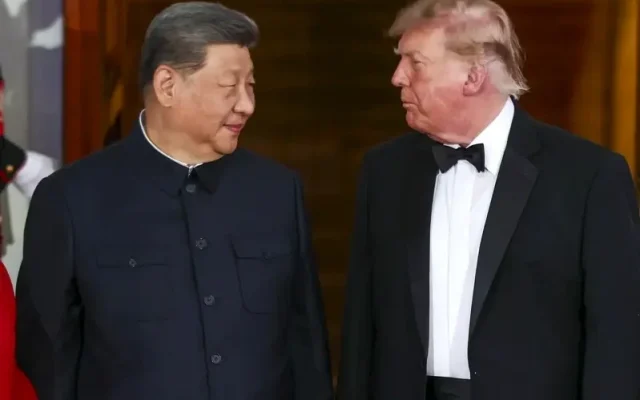
An interview with Kurt Campbell, the U.S. Deputy Secretary of State, was published by the South China Morning Post on the 12th. He stated that the Taiwan issue has become a topic of active discussion between U.S. President Donald Trump and Chinese President Xi Jinping, with both sides handling the dialogue cautiously. Campbell emphasized that the U.S. must demonstrate its resolve to maintain peace and stability across the Taiwan Strait; he warned that treating arms sales to Taiwan as a bargaining chip in U.S.-China negotiations could undermine U.S. credibility regarding its long-standing commitment to stability in the region.
Campbell, a co-founder of the Washington-based advisory firm The Asia Group and a key architect of U.S. Indo-Pacific strategy, served as Deputy Secretary of State from 2024 to early 2025. In the interview, he was asked whether the U.S. should maintain its policy of “strategic ambiguity” given China’s growing military capabilities and increasing pressure on Taiwan. He noted that a major, often overlooked achievement in U.S.-China relations has been the successful maintenance of peace and stability regarding the Taiwan issue over several decades. Despite periods of tension and disappointing developments, preserving the status quo remains in the best interest of the Taiwanese people.
Campbell acknowledged that the framework for peace across the Taiwan Strait—sustained by the U.S. and China for decades—is increasingly being tested by military and political developments, yet he remains convinced that this framework serves the interests of all parties. He pointed out that U.S. policy toward Taiwan is often described as “strategic ambiguity but tactical clarity,” making it essential for Washington to underscore its determination to uphold peace and stability.
Campbell further indicated that the Taiwan issue is currently a subject of cautious dialogue between U.S. and Chinese leaders, stating, “There is no denying that this issue has been raised and is being actively discussed.”
Regarding the possibility of including arms sales to Taiwan in U.S.-China negotiations, Campbell warned that treating such sales as a negotiable item could cast doubt on U.S. credibility—a credibility that has been a crucial factor in maintaining stability across the Taiwan Strait for decades.
The South China Morning Post also asked how a credible dialogue mechanism could be established between the two sides of the Taiwan Strait if Beijing continues to refuse engagement with Taiwan’s current administration. Campbell did not offer a direct solution but instead shifted the focus to US-China communication, noting that “despite profound differences between Washington and Beijing regarding the Taiwan issue, both sides share common interests—including crisis management, military-to-military communication, and mitigating the risk of accidental escalation.”
When asked whether the US would take action if China were to impose a quarantine or blockade on Taiwan rather than launching a conventional military attack, Campbell stated that, having left government service, it would be inappropriate for him to comment on specific scenarios; furthermore, publicly discussing various potential conflict scenarios could deepen mistrust and undermine stability.
Campbell argued that the US should maintain robust unofficial ties with Taiwan, acknowledge the issue’s significance within the broader US-China relationship, and handle the matter with caution and flexibility. He expressed confidence that, despite past turbulence, the US and China remain capable of taking the necessary steps to preserve peace and stability across the Taiwan Strait.
Turning to the overall US-China relationship, Campbell noted that leaders from both nations intend to stabilize bilateral ties—driven by a desire to enhance their respective competitive advantages as well as a genuine willingness to cooperate. However, he observed that while Trump devoted significant time and effort to strengthening US-China relations, he relatively neglected certain allies and partners. Campbell highlighted the alarming deterioration of US-Canada relations, emphasizing that the US must consolidate cooperation with its allies to effectively advance its technology strategy and uphold the global order.
When asked about the realistic objectives of US policy toward China, Campbell focused on the realm of artificial intelligence (AI). He pointed out that while Trump sought an AI dialogue with China, his insistence on US dominance risked leading Beijing to view the terms of cooperation as unfavorable, thereby diminishing its willingness to collaborate.